Mursi
Mursi or Murzu people, numbering about 47000, live in the Omo valley in the southwest of Ethiopia. They are nomadic cattle herders. They move in search of grazing and water for their cattle. When possible, they raise sorghum and corn.
The Mursi woman has a plate ("dhebi a tugoin") in her lower lip. Such plates are made of clay. They are being put by mother or some local woman. It is done for the first time when the woman is 15 or 16 years old.
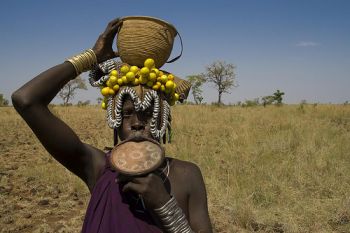 Mursi woman (photo by Marc Veraart)
Every girl decides how far to stretch the lip. It is achieved by putting progressively larger plates during several months. The diameter of a plate can be up to 12 centimeters. Plates are removed when eating.
Why local women wear such an unusual "ornament"? They are doing it as expression of becoming adult in social and biological sense.
The Mursi men, especially those single ones, find the ceremonial dueling or thagine highly important. The thagine is kind of martial arts using wooden poles and traditional protective clothing. Thagine events last for several days. Mursi people sometimes talk about the thagine as „war“ or kaman.
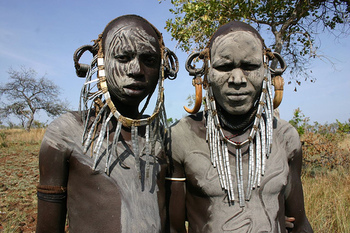 Mursi men
The wooden pole or donga that is used in duels is some two meters long. The pole is cut from the kalochi tree which belongs to the genus Grewia. When attacking a man holds donga at its base with both hands. He can hit any part of the opponent's body but only with the shaft of donga, never with the point. Each fighter wears special clothing called tumoga. Its purpose is both protective and decorative.
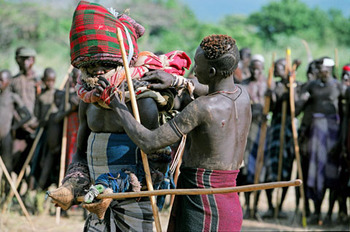 Thagine ceremonial dueling
For the fight not to go over the limit there is one or more referees or kwethani (plural kwethana). The fight is ended when one of opponents falls or retires because of injury.
If the victory is achieved by knocking off the opponent, the winner is celebrated in a big way. He is carried round the field on shoulders of the local men of the same age. Age grades represent important factor in Mursi society.
After that single girls, belonging to his mother's clan which are called „girl mothers“ or dole juge, surround him. They put goat skins on the ground so he can sit. Girls also prepare cotton cloth. They stretch it, on duelling poles, above the winner and that way provide him with shade. There is symbolic meaning in everything - a mother protects her baby from the sun.