Senbazuru
Senbazuru (Zenbazuru) is a group of one thousand origami cranes lined on a string.
Origami (in japanese oru - "folding", kami - "paper") is the traditional Japanese art of paper folding. The basic principle of origami is to make an object by using geometric folds and crease patterns. Everything should be done with no gluing or cutting the paper. Only one piece of paper is allowed to make one object.
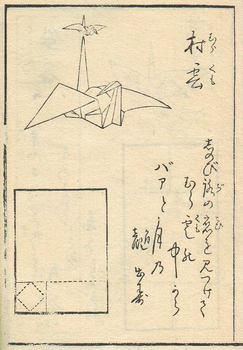 Hiden Senbazuru Orikata
According to experts beginnings of origami can be traced in the 8th century. Japanese aristocrats of that time noticed creases on paper when folded during wrapping of gifts. The oldest book about origami was published in 1797 as "Hiden Senbazuru Orikata" ("Secret to Folding One-thousand Cranes").
Origami paper used in making Senbazuru is in most cases of solid colour. Still, paper with printed designs can also be bought. Standard size of paper used is 7.5 x 7.5 cm (about 3 x 3 inches). Like in many other things rules are there to be broken. So, some people use any kind of paper like for example that of a magazine.
Individual origami cranes are assembled to 25 strings with 40 cranes on each string. Whole sets of 1000 sheets of paper for making your Senbuzuru are available. Few extra sheets are usually added in case you make a mistake. Strings and beads that prevent the cranes from slipping are also part of sets.
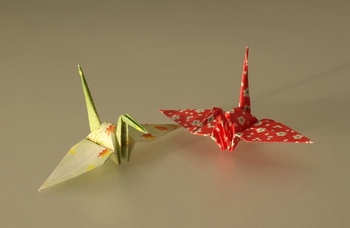 Origami cranes
Cranes are big birds with long legs and long necks. Cranes belong to the order Gruiformes, and family Gruidae. They are known for their beauty and spectacular mating dances. They became part of mythology in many cultures.
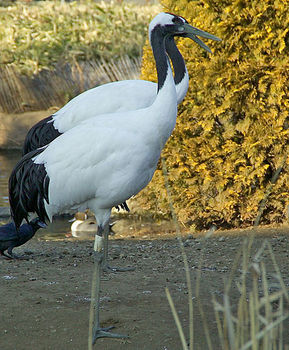 Red-crowned cranes
As to Japanese mythology, cranes („tancho“) belong to the mystical or holy animals (other two are dragon and tortoise). For the Japanese crane is "the bird of happiness" or "Honourable Lord Crane". Seeing two cranes at one time is known to be good luck.
It is believed that cranes live for thousand years. There are numerous Japanese legends about this belief. Let's mention the one about great warrior Yorimoto who lived in the 12th century. When he died his soul was transformed into a crane and flew away.
Yorimoto used to attach labels to the legs of cranes. This labels contained a short message asking all those who capture cranes to write the name of their place and then re-release the birds. Many centuries after Yorimoto's death there were reports by people claiming that they saw those cranes.
Cranes are a popular theme in the traditional Japanese art. Perfect example for this claim is the 15 metres long scroll with cranes made by Tawaraya Sotatsu in the early 17th century. The scroll is now kept in the Tokyo National Museum.
Why do people make Senbazuru? There is a legend which says that folding thousand origami cranes will make a wish, like for example long life or recovery from illness or injury, come true.
Senbazuru is traditionally given as a wedding present. It is a wish for a thousand years of happiness and prosperity for the couple. Many give Senbazuru to a newly born baby too.
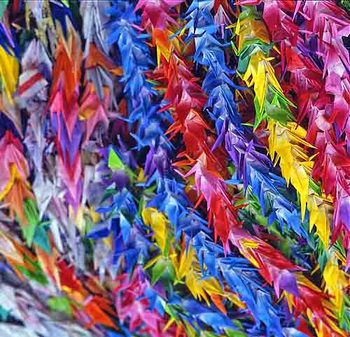 Senbazuru
People in Japan believe that having a Senbazuru hanged inside home will bring good luck. Relatively new tradition is the making of 1001 origami cranes. People started making this extra one just for good luck.
Senbazuru became part of literature. Many of you may have read the book "Sadako and the Thousand Paper Cranes", written in 1977, by the Canadian writer Eleanor Coerr. The book is based on a true story.
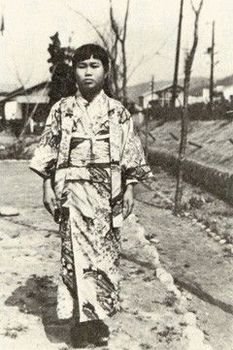 Sadako Sasaki
Sadako Sasaki (1943-1955) was a Japanese girl who got leukemia as result of radiation created by the atomic bomb (known also as „Little Boy“) that was dropped on Hiroshima on the 6th of August 1945. At the time of the explosion Sadako was at home, about 1 mile from ground zero.
First symptoms of a severe illness appeared in November of 1954 as lumps on her neck and behind her ears. In January of 1955 purple spots appeared on her legs. She was diagnosed with leukemia. She was hospitalized on the 21th of February, 1955.
Sadako's best friend Chihuko Hamamoto had been visiting her often. She encouraged Sadako to start making the thousand origami cranes. The popular version of story, as presented in the book by Eleanor Coerr, is that Sadako managed to finish 644 cranes before the death. She died on the 25th of October, 1955. The rest of cranes, until 1000, were made by her friends. She was buried with all 1000 cranes.
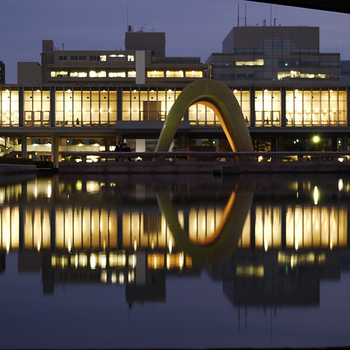 Hiroshima Peace Memorial Museum
Little bit different story about Sadako is presented in the Hiroshima Peace Memorial Museum. There it is stated that Sadako managed to make 1000 cranes by the end of August, 1955.
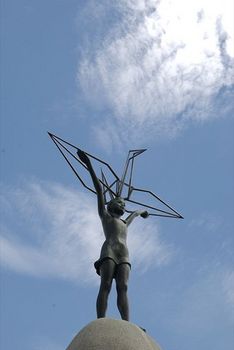 Sadako Sasaki, statue in Hiroshima
The statue of Sadako holding a golden crane in the Hiroshima Peace Park was unveiled in 1958. This monument is dedicated not only to Sadako but also to all the children died from the atomic bomb.
At the bottom of monument there is a text engraved - "This is our cry, This is our prayer, Peace in the world".
Sadako's story exists as a film too. There is a Japanese film "Senba-zuru" or "Sadako Story", as it is known internationally. This 96 minutes long film, made in 1989, was directed by Seijirô Kôyama.