Pongal
Pongal or Thai Pongal or is a harvest festival celebrated by the people of Tamil Nadu ("Country of the Tamils"). Tamil Nadu is one of 28 states in India. It is located in the south of India. It has population of 72,138,958 (2011). The capital of Tamil Nadu is Chennai.
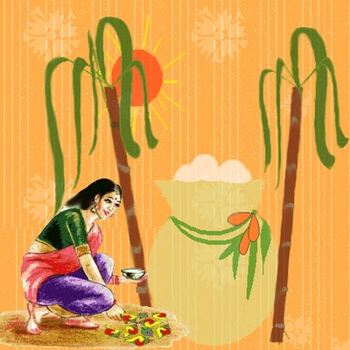 Pongal - the harvest festival of Tamil Nadu
Tamils in other parts of the world like for example Sri Lanka, Malaysia, Mauritius, South Africa, USA, Canada and Singapore celebrate Pongal too.
Pongal in Tamil means "boiling over or spill over". Boiling over of milk in the clay pot is believed to symbolize future wishes for the family.
The festival is more than 1000 years old. Some say even older. During medieval Chola empire the festival was known as Puthiyeedu. The empire reached its peak in the mid 9th century. It was the biggest empire in the south of India.
Pongal is celebrated between 12th and 15th of January. This is the time after the winter solstice when the days get longer and an abundant harvest.
Everybody is happy. Pongal is very important for all the Tamils. It is said that Pongal is "Tamizhar Thirunal" or "the festival of Tamils". The festival last four days from the last day of the Tamil month Maargazhi (December — January) to the third day of Thai (January — February).
The first day of Pongal is called Bhogi. On this day the Tamils burn old clothes and some other objects. This is a symbol of destroying old Thai and starting new one.
The main day of the festival is the second day. It is called Sarkarai Pongal or Veetu Pongal. Early in the morning people boil rice with fresh milk and jaggery or gur in new pots. Some brown sugar, cashew nuts and raisins are added later. Everything should boil over the pot. This tradition gave the festival its name.
It is a tradition to watch the moment the rice boils, bubbles appear and everything moves out of the pot. Then the person shouts "Ponggalo Ponggal"! It is a good sign, symbol of future prosperity.
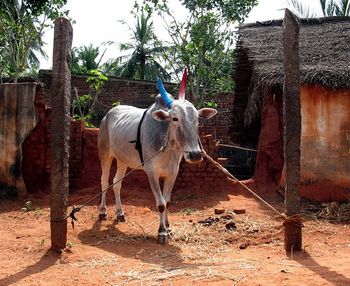 Cow decorated by its owner on the day of Maatu Pongal
The third day of festival is called Maatu Pongal. It is especially important for farmers. They are offering thanks to the cattle. On the Maatu Pongal farmers decorate cattle with paint, flowers and bells. Some wealthy people also put golden or other metal covers on top of horns. Cattle is allowed to roam freely. People feed them with sweet rice and sugar cane.
On Maatu Pongal people worship Lord Ganesh and Goddess Parvati. Pongal is offered to them in the "puja". There is a legend in which the origin of Maatu Pongal can be seen. One day Shiva sent his bull called Basava to Earth. His mission was to ask people to have an oil massage and bath every day and to eat once a month.
But the bull made a mistake. He said to people that they should eat every day and have an oil bath only once a month. Shiva was so angry when he found out what Basava did. Shiva cursed Basava to live on Earth forever. From that day on Basava ploughs fields and helps people to produce more food.
The fourth and final day of the festival is called Kaanum Pongal (in Tamil "kaanum" means to see). On this day people visit their friends and cousins. Many people chew sugar cane. Houses are decorated. Female family members use rice flour to create sort of sand painting called "kolam". It can be seen in front of every home. The Kaanum Pongal is also a start of many farmer's festivals all across Tamil Nadu.
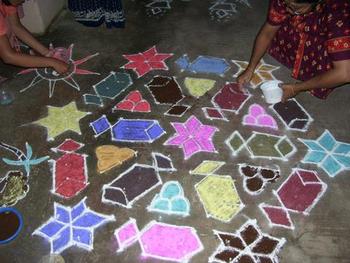 kolam sand painting
Pongal is also the start of new year for the Tamils. People thank God for all the good things in their life. Bad, evil things are left forever. Pongal is the day of new beginning in life. Tamils have a saying "Thai Pirandhal Vazhi Pirakkum" or "the birth of the month of Thai will pave the way for new opportunities".
Finally, let's just mention that there are many similar harvest festivals organized at about same time of year in other parts of the Indian subcontinent like Andhra Pradesh, Assam, Bengal, Bihar, Gujarat, Himachal Pradesh, Karnataka, Kerala, Orissa, Maharashtra, Nepal, the Punjab, Rajasthan and Uttar Pradesh.